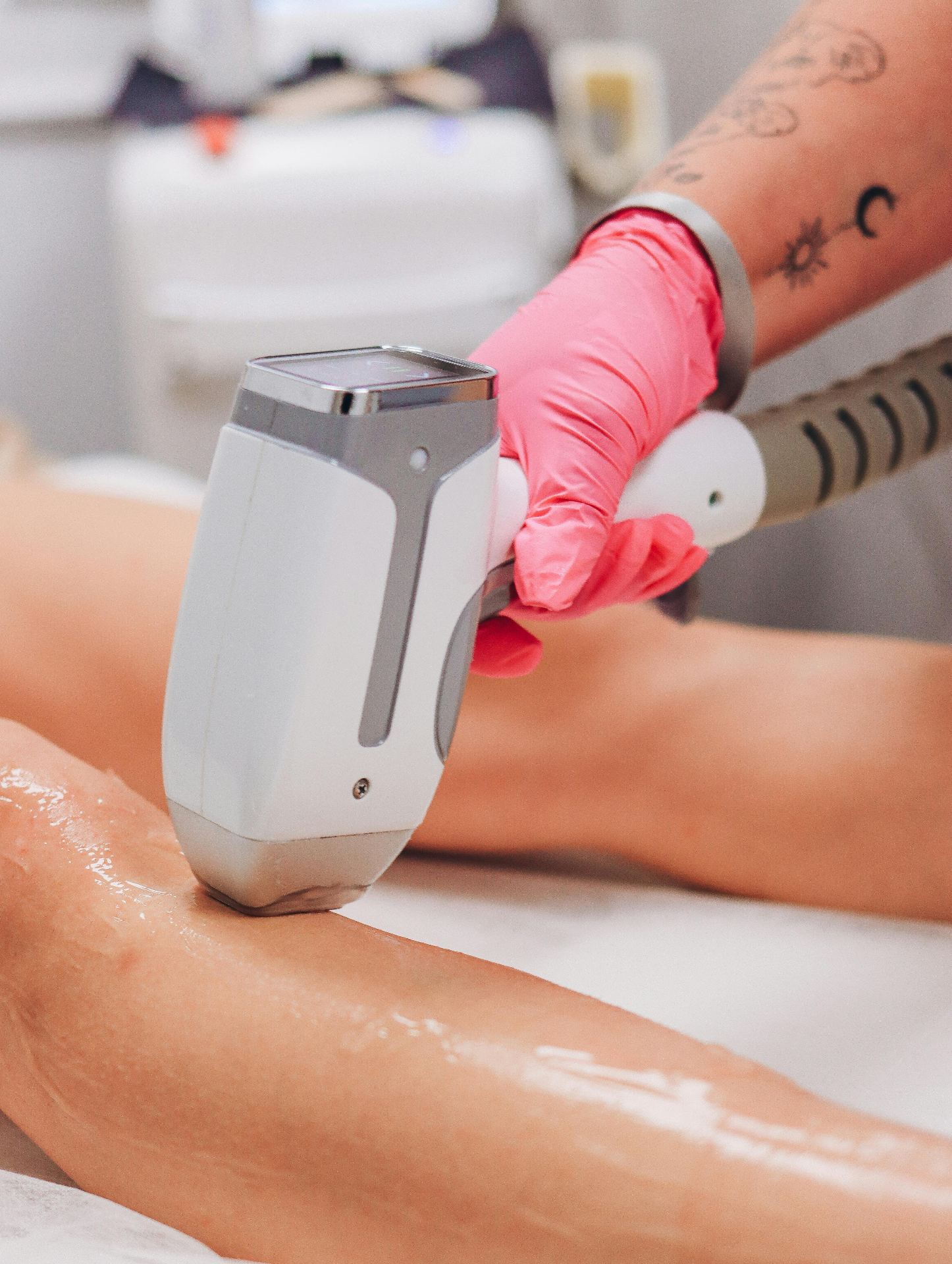
Every year it's the same. The first warm weekend arrives and the messages start coming in, asking if we can fit in some laser before a holiday that's three or four weeks away.
And every year I give the same slightly disappointing answer. Yes, you can start. No, you won't be finished.
Laser takes months, not weeks. It also works best on skin that hasn't seen much sun, which is exactly what a British summer gets in the way of (in a good year, anyway). So if you've been thinking about it, I'd honestly tell you to book in autumn. Here's why.
Why one session is never enough
Hair doesn't all grow at the same time. At any one moment, some of the hairs on your legs are actively growing, some are winding down, and some are simply resting in the follicle, waiting to fall out.
The laser can only really work on the ones that are growing. It heats the pigment in the hair, the heat travels down to the root, and that damages the part of the follicle that makes new hair. A resting hair isn't connected in the same way, so it mostly escapes.
That's why a single session only ever catches a batch. Four weeks later we catch the next batch, and so on.
At our studio the standard course is six sessions, at least four weeks apart. Some people need more than six. Coarse hair tends to, and so do hormonal areas like the chin and upper lip. Darker skin often needs a couple of extra sessions too, because we work at gentler settings to keep the skin safe.
Six sessions with four weeks between each is roughly six months. Which means the day you start decides the day you finish, and that's where autumn comes in.
Tanned skin and lasers don't mix
Laser finds hair by looking for pigment. Dark hair against lighter skin is ideal, because the energy goes straight into the hair and leaves the skin around it alone.
A tan muddies that. Your skin now carries more pigment of its own, so some of the laser's energy ends up in the skin instead of the hair. That's how people end up with blisters, or with patches that go darker or lighter for a while. It's also why a good practitioner will turn the settings down on tanned skin, or send you home and rebook you.
So our rules are strict, and I don't bend them. For two weeks before a session, the area stays out of the sun. That includes sunbeds. Fake tan counts too, because it sits in the top layer of your skin and the laser can't tell it apart from the real thing. Afterwards, it's SPF 30 or higher on that area every day for three weeks, and no sunbathing.
Try sticking to that in July. You can do it, but it means hiding in the shade at every barbecue and moving sessions every time the sun comes out. Between October and March most of us are pale and wrapped up anyway, so there's nothing to work around.
Start now and you're done by spring
If you start at the end of September and keep four weeks between sessions, your course lands roughly like this.
That's six sessions finished in March, with April and May spare in case you need a little extra. Start in November and you'll still normally be done by April or May.
One tip from experience. Book your first two or three sessions when you come in for the patch test. Christmas has a way of swallowing a whole month, and a gap that drifts from four weeks to eight just pushes your finish date back.
Now flip it round. Start in May and you're halfway through the course just as summer arrives. You spend the only properly warm months following the sun rules, and you go on holiday with the job half done.
There's a smaller, everyday reason too. A survey by BABTAC, the British Association of Beauty Therapy and Cosmetology, found the average woman in the UK shaves her underarms three times a week (source). Between now and June that's over a hundred shaves, for one area. I'd rather those months went on getting your course done.
On the day and the week after
The day itself is simple. Shave the area the night before rather than that morning, and come with clean skin. Skip the body lotion, and if we're doing your underarms, skip the deodorant too. Sessions are quicker than most people expect. Underarms take around fifteen minutes.
Afterwards, most people are surprised how quickly they're back to normal. You'll usually see some redness and small raised bumps around each hair, a bit like goosebumps. That's the heat doing its job, and it tends to settle within a day or two. Occasionally three.
For the first day or two, skip hot baths, saunas, steam rooms and hot tubs, and leave sweaty workouts until the skin calms down. A lukewarm shower is fine. Aloe vera or a panthenol cream helps if the area feels warm.
Then comes the part that catches people out. Somewhere between one and three weeks after your session, the treated hairs start falling out. For a few days it looks like regrowth, and I regularly get messages from people convinced it hasn't worked. It has. Gentle exfoliation from about day five helps them come away.
In winter, all of this happens under a jumper, which I think is underrated.
Keep shaving between sessions if you like. Just don't wax, pluck, thread or use an epilator. They pull out the root, and the root is what the laser needs to find.
What about Christmas and winter sun?
There's still some sun in autumn, I know. Plenty of people head somewhere warm in January, and December comes with its own run of parties.
None of that is a problem if we plan for it. Leave at least two weeks between getting back from a sunny holiday and your next session, and don't book a session in the two weeks before you fly. Take a proper high factor sunscreen for any treated area that'll be out, and keep topping it up.
If there's a big event, a wedding or the work Christmas do, I'd avoid treating whatever you'll have on show in the few days before. Redness is usually gone in a day or two, but why cut it fine?
Before your first session you'll need a patch test. We treat a small area, check how your skin reacts over the next day or two, and use that to choose your settings. At Astrabody it's free. Our laser uses four wavelengths (755, 808, 940 and 1064 nm), so we can adjust it to your skin tone and hair, including darker skin.
Where it struggles is very fair, red or grey hair, because there isn't enough pigment to aim at. If that's you, I'll tell you at the patch test rather than take your money.
So when should you book?
If summer is the goal, book in autumn. It gives your skin a break from the sun and gives the course enough time to finish before the warm weather comes back.
The easiest first step is the patch test. You can see how we treat each area on our laser hair removal page. And if you want the full picture of how the technology works, my complete guide to laser hair removal goes through it properly.
One honest caveat to finish on. Everyone's hair and skin are different, most people need the full course, and some areas need the odd extra session later on.
A few questions I get asked a lot
Can I start in the summer?
You can. It's just harder work. You'll need to keep the area out of the sun for two weeks before each session and wear SPF 30 or more every day for three weeks after. If you tan anyway, we may have to lower the settings or move your appointment.
How many sessions will I need?
Usually six, at least four weeks apart. Coarse hair, the face and darker skin can need a few more, and some people come back now and then for an extra session.
Will a winter holiday mess up my course?
Not if we plan around it. Keep two weeks clear either side of the trip and protect the treated areas with sunscreen while you're away.
Is November too late to start?
No. Starting in November, or even December, still normally gets a six session course finished in spring.
Why do I need a patch test?
It shows us how your skin reacts before we treat a whole area, and it's how we choose your settings. It's free at Astrabody, and we wait at least a day or two before your first full session.
Ready to start your journey?
Book a consultation to discuss your goals and create a personalised treatment plan.